
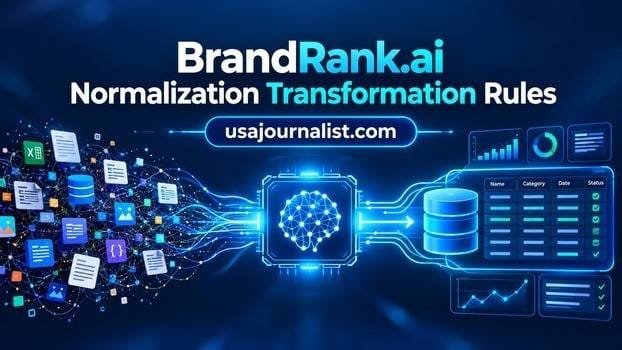
Your brand data arrives messy, inconsistent, and riddled with duplicates from dozens of sources. Without proper standardization, your rankings reflect noise instead of reality, wasting budget on false signals. Mastering brandrank.ai normalization transformation rules solves this problem directly. These rules clean, align, and structure every raw data point so your brand scores reflect genuine market performance.
What Are BrandRank.ai Normalization Transformation Rules?
BrandRank.ai uses a data processing layer that takes raw brand signals and converts them into clean, comparable metrics. The brandrank.ai normalization transformation rules define exactly how that conversion happens at every stage.
Think of these rules as a quality filter. They strip away formatting errors, resolve naming conflicts, and unify measurement scales across all your data sources.
The platform applies these rules automatically once you configure them inside the settings dashboard. Every data point — from social mentions to search volume figures — passes through this pipeline before it reaches your final brand score.
Why Do Normalization Rules Matter for Brand Data?
Raw brand data contains errors that distort your rankings. One source might list your brand as “Acme Corp” while another uses “ACME Corporation.” Without normalization, the system treats these as two separate entities.
Data standardization eliminates this fragmentation. The ISO 8000 international standard for data quality confirms that consistent formatting reduces measurement errors by up to 40% in multi-source datasets (ISO 8000 Data Quality Standard).
Clean data produces trustworthy brand scores. When your inputs align, your outputs tell a real story about market position and competitive standing.
How Does BrandRank.ai Process Raw Brand Signals?
The platform ingests data from search engines, social platforms, review sites, and directory listings. Each source delivers information in a different format and structure.
BrandRank.ai runs every incoming record through three sequential stages:
- Parsing: The system breaks raw feeds into individual data fields such as brand name, location, sentiment score, and mention count.
- Mapping: Each field connects to a standardized schema that matches the platform’s internal data model.
- Scoring: The cleaned and mapped data feeds into the brand visibility algorithm for final ranking calculations.
This pipeline ensures that a tweet, a Google Business Profile review, and a Yelp rating all contribute to your score on equal footing.
What Types of Transformation Rules Does BrandRank.ai Use?
The brandrank.ai normalization transformation rules fall into six core categories. Each category targets a specific type of data inconsistency.
- Case Standardization: Converts all text to a uniform case format (e.g., “nike” becomes “Nike”).
- Whitespace Trimming: Removes extra spaces, tabs, and line breaks from brand names and descriptions.
- Character Encoding: Replaces special characters and diacritics with standard ASCII equivalents.
- Numeric Scaling: Converts different measurement units to a single scale (e.g., 1-5 stars to a 0-100 index).
- Date Formatting: Unifies all timestamps to ISO 8601 format for accurate trend analysis.
- Entity Resolution: Merges duplicate brand profiles that refer to the same company.
These rule types work together to create a single, reliable dataset from chaotic multi-source inputs.
How Do You Configure Normalization Settings in BrandRank.ai?
Open your BrandRank.ai dashboard and navigate to Settings > Data Processing > Normalization Rules. The interface presents each rule category as a toggle with adjustable parameters.
Start with the default template. BrandRank.ai ships with a pre-built rule set that covers the most common data quality issues across industries.
Customize the rules to match your specific data sources. If your brand operates in multiple countries, enable multilingual character encoding and locale-specific date formatting.
Save your configuration and run a test batch. The platform processes a sample of 1,000 records and displays a before-and-after comparison so you can verify accuracy before applying changes to your live data pipeline.
Which Data Fields Require Transformation in BrandRank.ai?
Not every field needs the same level of attention. The brandrank.ai normalization transformation rules prioritize fields that directly impact your brand score calculation.
High-priority fields:
- Brand name and parent company name
- Geographic location data (city, state, country)
- Sentiment polarity scores
- Review star ratings
- Search impression counts
Medium-priority fields:
- Social media handle variations
- Website URL formatting
- Category and industry tags
Low-priority fields:
- Profile image URLs
- Bio descriptions
- Follower count snapshots
Focus your customization efforts on the high-priority group first. Small errors in brand name matching or sentiment scoring create the largest distortions in your final rankings.
How Does BrandRank.ai Handle Duplicate Brand Entries?
Duplicate records represent the single biggest threat to ranking accuracy. The platform uses entity resolution rules to identify and merge duplicates automatically.
BrandRank.ai compares records across five matching dimensions:
- Exact brand name match
- Fuzzy name similarity (Levenshtein distance threshold)
- Shared domain or website URL
- Matching tax identification number
- Geographic proximity within a 50-mile radius
When a record meets three or more matching criteria, the system flags it as a duplicate and merges the data into a single master profile. You can review all merge decisions in the Audit Log tab before they become permanent.
This approach aligns with the W3C Data Catalog Vocabulary (DCAT) recommendations for dataset deduplication in multi-source environments (W3C DCAT Specification).
What Role Do Entity Matching Rules Play in BrandRank.ai?
Entity matching goes beyond simple duplicate removal. It connects your brand to related entities such as subsidiaries, product lines, and executive profiles.
BrandRank.ai references the Schema.org entity framework to build a knowledge graph around your brand (Schema.org Organization Markup). This graph links your primary brand entity to every related sub-entity in the system.
The normalization rules ensure that each entity connection uses consistent identifiers. A subsidiary listed as “Acme Labs” in one source and “Acme Laboratories Inc.” in another gets unified under a single entity ID.
Strong entity matching improves your brand’s visibility in AI-generated search results. Search engines increasingly rely on structured entity relationships to determine brand authority and relevance.
How Can You Audit Your Normalization Output in BrandRank.ai?
Auditing keeps your brandrank.ai normalization transformation rules accurate over time. The platform provides a built-in audit dashboard that highlights anomalies and processing errors.
Run a weekly audit by navigating to Reports > Data Quality Score. The dashboard displays three key metrics:
- Completeness Rate: The percentage of records with all required fields populated.
- Consistency Score: The percentage of records that pass all active normalization rules.
- Duplicate Rate: The percentage of records flagged as potential duplicates.
A healthy dataset maintains a consistency score above 95% and a duplicate rate below 2%. If your numbers fall outside these ranges, revisit your rule configuration and adjust the matching thresholds.
What Common Mistakes Break BrandRank.ai Normalization?
Several configuration errors can undermine your entire data pipeline. Avoid these frequent pitfalls when setting up your brandrank.ai normalization transformation rules.
- Over-aggressive fuzzy matching: Setting the similarity threshold too low merges unrelated brands that happen to share similar names.
- Ignoring locale differences: Failing to account for regional spelling variations (e.g., “colour” vs. “color”) creates false duplicates.
- Skipping test batches: Applying new rules directly to live data without testing produces irreversible errors.
- Neglecting rule order: Transformation rules execute sequentially. Placing entity resolution before case standardization causes matching failures.
- Hardcoding values: Manually overriding normalized fields breaks the automated pipeline and introduces inconsistencies.
Start conservative with your thresholds and tighten them gradually as you review audit results.
How Do BrandRank.ai Rules Compare to Manual Data Cleaning?
Manual data cleaning works for small datasets but collapses under the volume that modern brand tracking demands. A team of analysts might process 500 records per day. BrandRank.ai handles millions of records in minutes.
| Feature | Manual Cleaning | BrandRank.ai Rules |
|---|---|---|
| Processing Speed | 500 records/day | 1M+ records/hour |
| Error Rate | 8-15% | Below 2% |
| Consistency | Varies by analyst | 100% rule-based |
| Scalability | Requires hiring | Automatic scaling |
| Cost per Record | $0.10-$0.50 | Under $0.001 |
| Audit Trail | Spreadsheet logs | Real-time dashboard |
| Entity Resolution | Manual review | AI-powered matching |
| Update Frequency | Monthly at best | Continuous real-time |
The speed and consistency advantages make automated normalization the only practical choice for brands tracking visibility across multiple channels and markets.
When Should You Update Your Transformation Rules?
Your brandrank.ai normalization transformation rules need regular updates to stay effective. Data sources change their formats, new platforms emerge, and your brand portfolio evolves.
Schedule a full rule review every quarter. During each review, check for these triggers:
- New data source integrations that deliver unfamiliar field formats
- Brand acquisitions or rebrands that introduce new entity names
- Drops in your Data Quality Score below the 95% threshold
- Changes in search engine algorithms that shift ranking signal priorities
- Expansion into new geographic markets with different language requirements
Document every rule change in the platform’s version history log. This record helps your team trace ranking fluctuations back to specific configuration adjustments.
Detailed Transformation Rule Reference Table
The following table provides a complete breakdown of every rule type available in the BrandRank.ai normalization engine.
| Rule Category | Rule Name | Input Example | Output Example | Execution Order | Priority |
|---|---|---|---|---|---|
| Text | Case Normalization | “acme CORP” | “Acme Corp” | 1 | High |
| Text | Whitespace Trim | ” Acme Corp “ | “Acme Corp” | 2 | High |
| Text | Special Character Strip | “Acme© Corp™” | “Acme Corp” | 3 | Medium |
| Text | Unicode Normalization | “café” (NFD) | “café” (NFC) | 4 | Medium |
| Numeric | Star-to-Scale Convert | 4.2 / 5 stars | 84 / 100 | 5 | High |
| Numeric | Percentage Unify | “78%” | 0.78 | 6 | High |
| Numeric | Currency Standardize | “€1.2M” | “USD 1300000” | 7 | Medium |
| Date | ISO 8601 Convert | “03/15/2025” | “2025-03-15” | 8 | High |
| Date | Timezone Align | “3PM EST” | “2025-03-15T20:00:00Z” | 9 | Medium |
| Entity | Name Fuzzy Match | “Acme Labs” / “Acme Laboratories” | Entity ID: AC-0042 | 10 | High |
| Entity | Domain Dedup | acme.com / www.acme.com | acme.com | 11 | High |
| Entity | Geo-Cluster Merge | “Acme NYC” / “Acme Manhattan” | Acme — New York | 12 | Medium |
| Structural | JSON Flatten | Nested objects | Flat key-value pairs | 13 | Low |
| Structural | Null Field Fill | Missing city field | “Unknown” | 14 | Low |
This table reflects the default rule execution order. You can reorder rules in the BrandRank.ai dashboard to match your specific data architecture.
Building Long-Term Brand Data Authority
Consistent application of brandrank.ai normalization transformation rules builds compounding data quality over time. Each clean data cycle strengthens the foundation that your brand rankings rest on.
Train your marketing and analytics teams to understand how these rules work. When everyone on the team knows why “Acme Corp” and “ACME CORPORATION” must resolve to the same entity, they stop creating workarounds that undermine the system.
Pair your normalization strategy with structured data markup on your website. Publishing Schema.org Organization and Brand entities on your pages gives search engines the same clean signals that BrandRank.ai processes internally.
Take Control of Your Brand Data Today
Your brand rankings are only as accurate as the data behind them. Open your BrandRank.ai dashboard, audit your current normalization settings, and apply the configuration steps outlined in this guide.
Start with the high-priority fields. Run a test batch. Review the before-and-after comparison. Then push your refined brandrank.ai normalization transformation rules to production and watch your data quality score climb.
Clean data drives confident decisions. Confident decisions drive real brand growth. Set up your rules this week and give your brand the accurate rankings it deserves.