How to Master escribir conjugation Fast
 Admin USA Journalist
Introduction
Struggling to remember how to change Spanish verbs to match who is speaking? Learning es escribir conjugation correctly can feel confusing when you mix up verb endings across different tenses. Master the regular -ir verb patterns today. Unlock fluent Spanish communication effortlessly with this complete, step-by-step guide designed for learners at every level.
What Is Escribir and Why Does Conjugation Matter?
Escribir is a foundational Spanish regular verb meaning “to write.” Mastering escribir conjugation allows you to talk about school assignments, text messages, books, and letters.
Because Spanish verbs change their endings based on who performs the action and when it happens, learning these patterns unlocks hundreds of other regular -ir verbs instantly.
Present Indicative Tense (Presente de Indicativo)
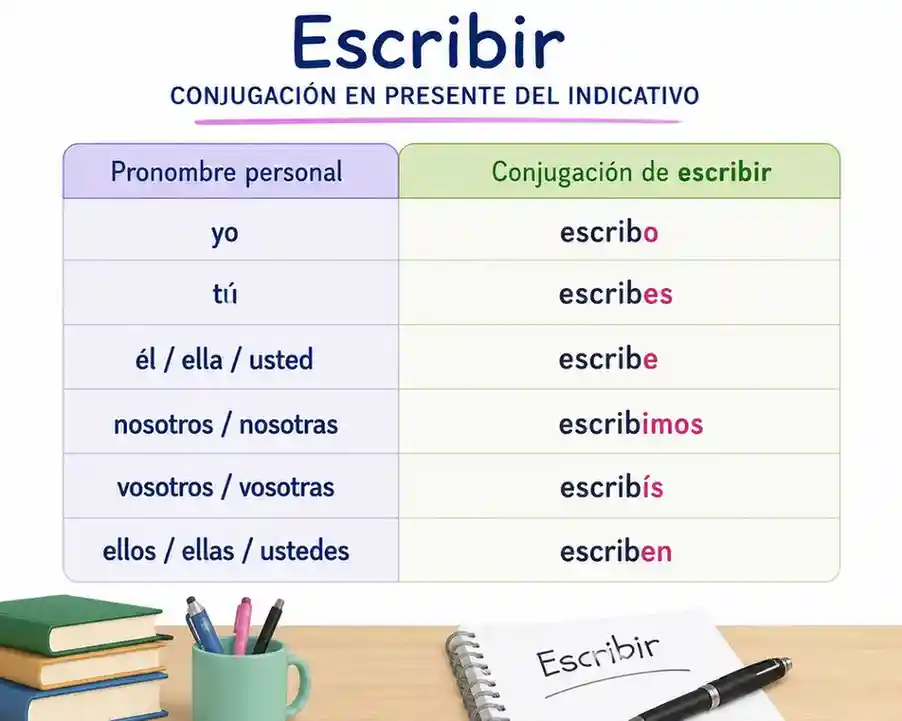
The present indicative tense describes actions happening right now or general habits. Since escribir follows standard regular -ir verb rules, you simply drop the -ir ending and add the matching personal suffix.
- Yo escribo (I write)
- Tú escribes (You write – informal)
- Él / Ella / Usted escribe (He / She / You write – formal)
- Nosotros / Nosotras escribimos (We write)
- Vosotros / Vosotras escribís (You all write – Spain)
- Ellos / Ellas / Ustedes escriben (They / You all write)
Each form of escribir conjugation in the present tense keeps the stem escrib- intact, making memorization straightforward.
Preterite Tense (Pretérito Indefinido)
When you want to talk about actions completed entirely in the past, use the preterite tense. Perfecting past tense escribir conjugation helps you share stories about what you wrote yesterday or last year.
- Yo escribí (I wrote)
- Tú escribiste (You wrote)
- Él / Ella / Usted escribió (He / She / Usted wrote)
- Nosotros / Nosotras escribimos (We wrote)
- Vosotros / Vosotras escribisteis (You all wrote)
- Ellos / Ellas / Ustedes escribieron (They wrote)
Notice that the first-person plural form (escribimos) is identical in both the present and preterite tenses. Context always makes the intended time clear.
Imperfect Tense (Pretérito Imperfecto)
The imperfect tense describes ongoing, habitual, or background actions in the past (e.g., “I used to write letters every summer”). For all regular -ir verbs, the imperfect adds standard -ía endings.
- Yo escribía (I used to write / I was writing)
- Tú escribías (You used to write)
- Él / Ella / Usted escribía (He / She / You used to write)
- Nosotros / Nosotras escribíamos (We used to write)
- Vosotros / Vosotras escribíais (You all used to write)
- Ellos / Ellas / Ustedes escribían (They used to write)
Applying correct escribir conjugation here gives your storytelling a natural, native rhythm.
Future Tense (Futuro Simple)
Looking ahead to tomorrow? The future tense is one of the easiest to learn because you attach endings directly to the full infinitive verb escribir rather than dropping any letters.
- Yo escribiré (I will write)
- Tú escribirás (You will write)
- Él / Ella / Usted escribirá (He / She / Usted will write)
- Nosotros / Nosotras escribiremos (We will write)
- Vosotros / Vosotras escribiréis (You all will write)
- Ellos / Ellas / Ustedes escribirán (They will write)
Mastering future tense escribir conjugation ensures you can confidently make plans for upcoming writing projects or exams.
Conditional Tense (Condicional Simple)
The conditional tense expresses what you would do under certain circumstances (e.g., “I would write a book if I had more free time”). Like the future tense, it builds directly on the full infinitive escribir.
- Yo escribiría (I would write)
- Tú escribirías (You would write)
- Él / Ella / Usted escribiría (He / She / You would write)
- Nosotros / Nosotras escribiríamos (We would write)
- Vosotros / Vosotras escribiríais (You all would write)
- Ellos / Ellas / Ustedes escribirían (They would write)
Using conditional escribir conjugation correctly adds politeness and nuance to your Spanish conversations.
Present Subjunctive (Presente de Subjuntivo)
The subjunctive mood expresses wishes, doubts, emotions, or hypothetical situations. To form the present subjunctive, take the yo form from the present indicative (escribo), drop the -o, and add subjunctive endings (-a, -as, -a, -amos, -áis, -an).
- Que yo escriba (That I write)
- Que tú escribas (That you write)
- Que él / ella / usted escriba (That he / she / you write)
- Que nosotros / nosotras escribamos (That we write)
- Que vosotros / vosotras escribáis (That you all write)
- Que ellos / ellas / ustedes escriban (That they write)
Advanced fluency requires mastering subjunctive escribir conjugation for complex sentence structures.
Imperative Mood (Commands)
Giving orders or suggestions requires the imperative mood. Direct commands for escribir conjugation vary depending on whether you tell someone to do something or not to do it.
- ¡Escribe tú! (Write! – informal positive)
- ¡No escribas! (Do not write! – informal negative)
- ¡Escriba usted! (Write! – formal positive)
- ¡Escribamos! (Let’s write!)
- ¡Escribid vosotros! (Write! – Spain plural positive)
- ¡Escriban ustedes! (Write! – formal plural positive)
Clear commands help you guide others smoothly during collaborative writing tasks.
Complete Reference Table
| Tense / Mood | Yo | Tú | Él / Ella / Usted | Nosotros | Vosotros | Ellos / Ellas / Ustedes |
| Present | escribo | escribes | escribe | escribimos | escribís | escriben |
| Preterite | escribí | escribiste | escribió | escribimos | escribisteis | escribieron |
| Imperfect | escribía | escribías | escribía | escribíamos | escribíais | escribían |
| Future | escribiré | escribirás | escribirán | escribiremos | escribiréis | escribirán |
| Conditional | escribiría | escribirías | escribiría | escribiríamos | escribiríais | escribirían |
| Subjunctive | escriba | escribas | escriba | escribamos | escribáis | escriban |
Common Mistakes to Avoid
- Confusing verb endings: Mixing up -ir endings with -ar endings (like hablar) is a common rookie error. Always remember that escribir conjugation uses characteristic i sounds across most regular forms.
- Neglecting accent marks: Written accents change meanings entirely. Notice how escribí (past tense) differs from escribi (which is incorrect).
- Forgetting stem consistency: Because escribir is regular, the stem escrib- never changes spelling vowels. Do not accidentally add unauthorized stem changes.
Frequently Asked Questions
Is escribir a regular or irregular verb?
Answer: Escribir is a completely regular -ir verb in Spanish. It follows standard grammatical endings without any unexpected stem changes across all standard moods and tenses.
How do you conjugate escribir in the past tense?
Answer: For the preterite past tense, use: escribí, escribiste, escribió, escribimos, escribisteis, and escribieron. For the imperfect past tense, use: escribía, escribías, escribía, escribíamos, escribíais, and escribían.
What is the future tense form of escribir for “we”?
Answer: The future tense form for “we” (nosotros) is escribiremos, formed by adding -emos directly to the full infinitive verb.
Can escribir be used with direct and indirect object pronouns?
Yes, pronouns attach directly to the end of the infinitive (escribir), gerund (escribiendo), or affirmative commands (escríbelo), or go right before conjugated verbs.
What is the gerund form of escribir?
The present participle (gerund) form is escribiendo, which translates to “writing” in English (e.g., Estoy escribiendo una carta).
Why do Spanish verb charts include vosotros?
The vosotros pronoun is used primarily in Spain for informal plural “you all.” While Latin American Spanish uses ustedes instead, knowing vosotros forms ensures complete comprehension.
Conclusion
Mastering escribir conjugation gives you a powerful tool to express your thoughts, stories, and ideas accurately in Spanish. Practice these verb charts daily, apply them in real sentences, and watch your language fluency soar. Start writing your first Spanish paragraph today and take a confident step toward total bilingual mastery!
Recommended For You