
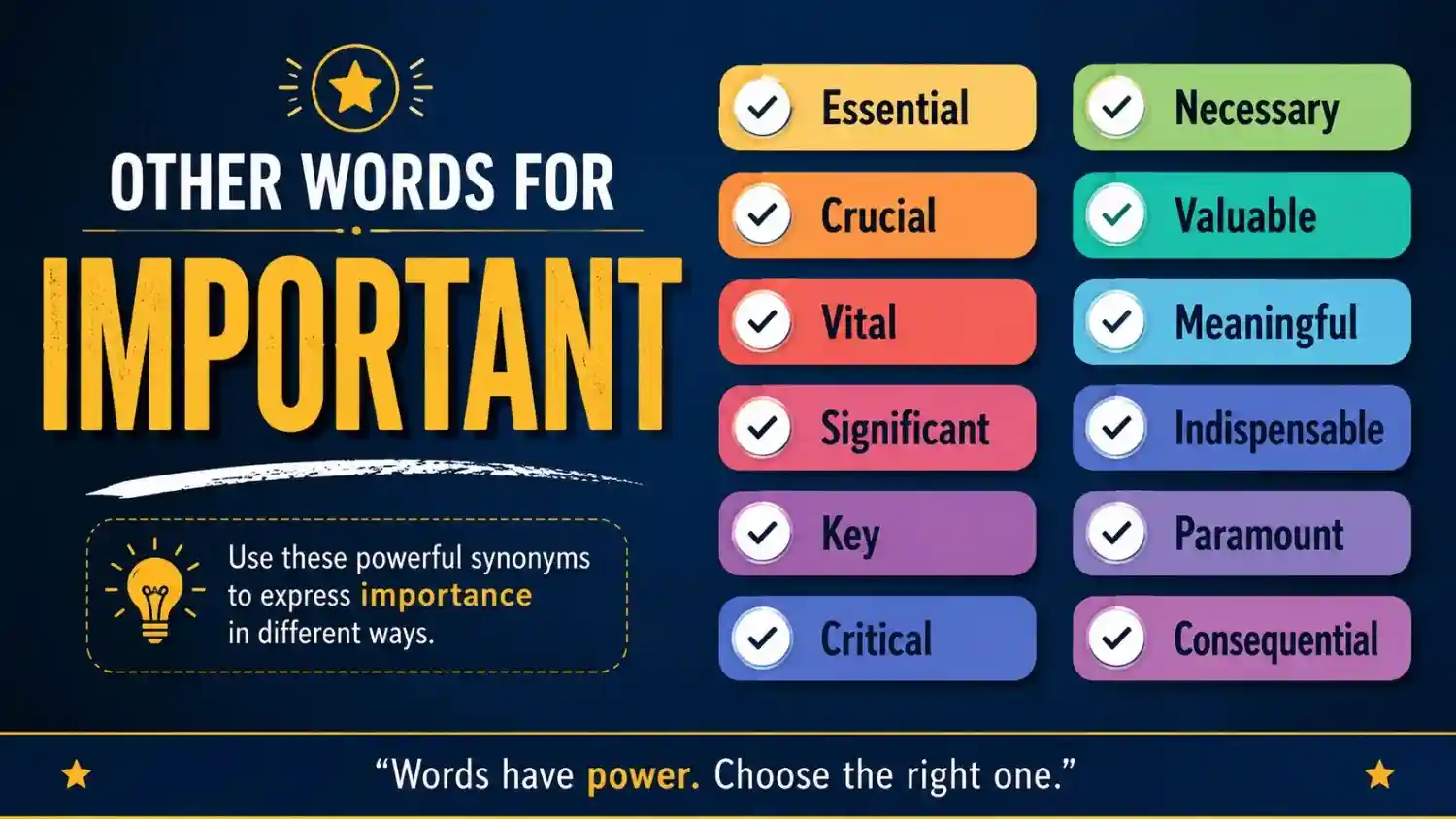
Other Words for Important: How to Elevate Your Writing Instantly
 Admin USA Journalist
Introduction
Finding the right vocabulary can feel exhausting when your writing relies on the same tired adjectives. Using other words for important transforms flat sentences into compelling statements that immediately capture attention. Discover practical vocabulary upgrades to make your content shine today.
Why Relying on “Important” Harms Your Writing
Relying on generic vocabulary drains the energy right out of your sentences. When every single paragraph claims that something is important, readers stop believing you.
- Loss of Impact: Overuse dilutes the true value of your points.
- Reader Fatigue: Repetitive language makes reading feel like a chore.
- Lack of Precision: It fails to explain why something matters.
1. Crucial: When Failure Is Not an Option
Something crucial holds the entire weight of a project or decision together. Without it, everything falls apart. Use this when stakes are exceptionally high and success depends on a specific action.
- Example: Securing funding is crucial for launching the startup.
- Best Used For: Business strategies, emergency plans, and core requirements.
2. Vital: Essential for Life and Success
Vital connects directly to the life force or core survival of a system, body, or organization. Think of it as the oxygen your content needs to breathe.
- Example: Clear communication remains vital for remote team success.
- Best Used For: Health topics, operational steps, and fundamental needs.
3. Significant: Meaningful and Worthy of Attention
Significant points to measurable impact or deep meaning. Instead of just saying an idea matters, this proves it by highlighting its consequences or value.
- Example: The study revealed significant improvements in patient recovery.
- Best Used For: Research findings, data analysis, and major milestones.
4. Critical: The Turning Point of Decision-Making
Critical situations demand immediate focus because a tipping point is near. It signals that careful evaluation or urgent problem-solving must take place right now.
- Example: Fixing server bugs is a critical step before software release.
- Best Used For: Technical troubleshooting, risk management, and urgent updates.
5. Imperative: Absolute Necessity and Command
An imperative demand carries authority and urgency. It transcends mere recommendation, acting as a clear directive that demands immediate follow-through.
- Example: It is imperative to back up your data daily.
- Best Used For: Policy guidelines, safety rules, and strict instructions.
6. Paramount: Surpassing All Others in Importance
Paramount places a specific goal or value at the very top of the priority list. Nothing else ranks higher than this single objective.
- Example: Client satisfaction is paramount to our agency’s growth.
- Best Used For: Core values, mission statements, and top priorities.
7. Fundamental: The Bedrock of Every Strong Concept
Fundamental ideas serve as the building blocks for everything else that follows. Without this foundational base, advanced concepts cannot stand securely.
- Example: Learning basic grammar rules is fundamental for writers.
- Best Used For: Educational guides, introductory steps, and foundational theories.
8. Pivotal: The Pivot Point for Major Change
Pivotal moments change the entire direction of a story, project, or career. It marks the exact instant where old paths end and exciting new directions begin.
- Example: Landing that first big client was a pivotal moment.
- Best Used For: Career milestones, historical events, and strategic pivots.
9. Master Comparison Table: Choosing the Right Term
| Term | Primary Nuance | Best Context | Example Application |
| Crucial | High stakes | Business & Survival | A crucial deadline approaches. |
| Vital | Life-sustaining | Health & Operations | Water is vital for plant growth. |
| Significant | Meaningful impact | Data & Research | A significant discovery was made. |
| Critical | Urgent assessment | Troubleshooting | A critical error stopped the app. |
| Imperative | Strict necessity | Rules & Directives | Safety checks are imperative. |
| Paramount | Top priority | Core Values | Quality control is paramount. |
| Fundamental | Foundational base | Education & Basics | Trust is a fundamental rule. |
10. How to Choose the Right Alternative Every Time
Selecting the best term depends entirely on context and emotional resonance. Match the vocabulary weight to the actual gravity of the topic you are discussing.
- Evaluate the Stakes: Ask yourself how much damage occurs if this fails.
- Consider the Audience: Match tone with professional or casual expectations.
- Read Aloud: Listen for natural rhythm and flow in your sentences.
Frequently Asked Questions
What are the best other words for important in professional writing?
Terms like crucial, significant, and paramount elevate professional writing by adding precision and authority without sounding overly dramatic.
Can I use critical as a direct substitute for important?
Yes, critical works wonderfully when a situation is urgent, time-sensitive, or involves high-stakes decision-making.
Why should I avoid repeating the word important?
Repetitive vocabulary makes writing feel monotonous and dulls the persuasive power of your arguments.
What is a good alternative for important in casual conversations?
Words like big, key, or major keep casual conversations natural while breaking away from repetitive habits.
How do I know which synonym fits my sentence best?
Match the intensity of the synonym to the actual weight of your subject, ensuring the context aligns with the definition.
Where can I verify correct usage of these vocabulary terms?
Authoritative language references like the Merriam-Webster Dictionary, the Chicago Manual of Style, and Purdue OWL provide exceptional guidance.
Conclusion
Mastering other words for important instantly elevates your communication, builds reader trust, and transforms ordinary sentences into engaging content. Start replacing repetitive habits with precise vocabulary in your very next paragraph and watch your writing thrive.
Recommended For You