Mastering Ser Conjugation: Your Ultimate Guide to Spanish Mastery
 Admin USA Journalist
Struggling to remember how and when to use ser conjugation in everyday Spanish conversations can make you feel completely stuck and frustrated. You want to sound fluent, but mixing up your verbs holds you back from expressing your true thoughts. Fortunately, mastering ser conjugation is simpler than you think when you break it down step by step.
What is Ser and Why Does It Matter?
The verb ser translates to “to be” in English, but it represents permanent or lasting traits. Understanding ser conjugation forms the absolute backbone of Spanish grammar because you use it constantly. Without it, you cannot introduce yourself, state your nationality, or describe your personality.
- Core building block of Spanish sentences
- Used for permanent characteristics and identities
- Essential for daily communication
How to Conjugate Ser in the Present Tense
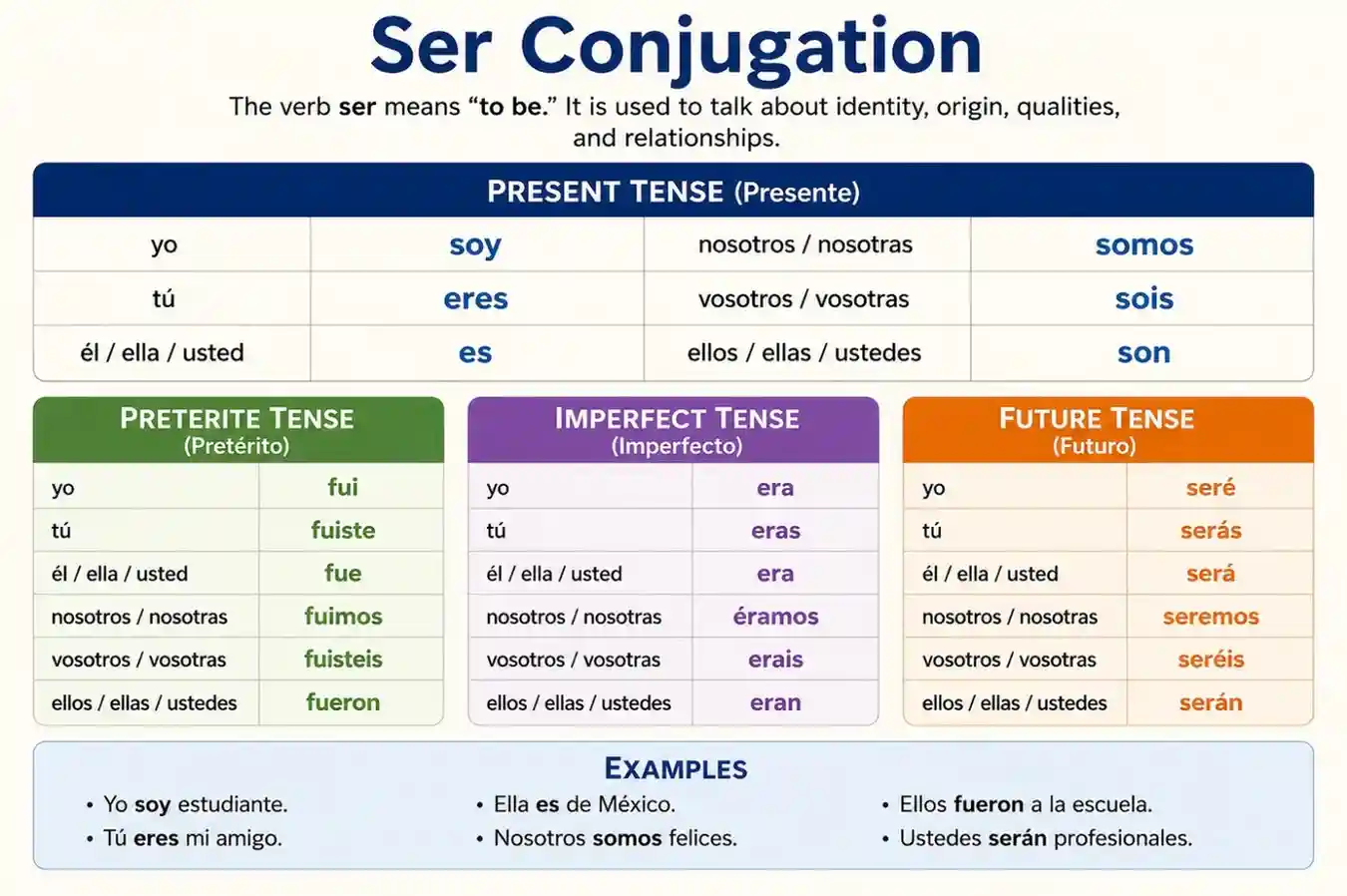
The present tense is your starting point for using ser conjugation correctly in real-life conversations. Each pronoun pairs with a specific form that never changes. Practicing these baseline forms builds immediate confidence.
- Yo soy (I am)
- Tú eres (You are – informal)
- Él / Ella / Usted es (He / She / You – formal is)
- Nosotros somos (We are)
- Vosotros sois (You all are – Spain)
- Ellos / Ellas / Ustedes son (They / You all are)
Ser Conjugation Master Table
| Pronoun (Subject) | Present Tense | Preterite (Past) | Imperfect (Past) | Future Tense |
| Yo | soy | fui | era | seré |
| Tú | eres | fuiste | eras | serás |
| Él / Ella | es | fue | era | será |
| Nosotros | somos | fuimos | éramos | seremos |
| Vosotros | sois | fuisteis | erais | seréis |
| Ellos / Ustedes | son | fueron | eran | serán |
When to Use Ser: The DOCTOR Rule
Memorizing ser conjugation is only half the battle; you also need to know when to apply it. Native speakers rely on specific triggers to separate permanent states from temporary ones. Linguists and educators often use the acronym DOCTOR to make this rule effortless to remember.
- Descriptions (e.g., She is tall)
- Occupations (e.g., He is a doctor)
- Characteristics (e.g., They are kind)
- Time (e.g., It is two o’clock)
- Origin (e.g., I am from Canada)
- Relationships (e.g., Maria is my sister)
Ser Conjugation in the Past: Preterite vs. Imperfect
Talking about things that happened yesterday requires looking at past forms of ser conjugation. The preterite tense handles completed actions with a clear endpoint. Meanwhile, the imperfect tense describes ongoing past situations or background traits.
- Preterite example: Fui estudiante (I was a student for a specific period).
- Imperfect example: Era alto (He was tall when he was younger).
- Both past forms share the exact same root words (fu- for preterite and er- for imperfect).
Looking Ahead: The Future and Conditional Tenses
Planning for tomorrow means you need future forms of ser conjugation in your toolkit. The future tense tells people what something will become. Conversely, the conditional tense lets you express what something would be under different circumstances.
- Future form: Seré mejor mañana (I will be better tomorrow).
- Conditional form: Sería un buen trabajo (It would be a good job).
- Regular ending patterns make these tenses very easy to memorize.
Subjunctive Mood with Ser Conjugation
Expressing doubts, wishes, or emotions requires the subjunctive mood. Mastering subjunctive ser conjugation takes your Spanish writing and speaking to an advanced level. It unlocks the ability to share hypothetical opinions smoothly.
- Present subjunctive: Es importante que sea verdad (It is important that it be true).
- Imperfect subjunctive: Quería que fuera fácil (I wanted it to be easy).
- Mastering these forms impresses native speakers instantly.
Common Mistakes to Avoid with Ser
Mixing up ser and estar is the number one trap for Spanish learners. While ser covers permanent traits, estar handles temporary locations and feelings. Keeping this distinction clear prevents embarrassing translation errors.
- Do not use ser for temporary moods like happiness or sadness.
- Do not use ser for physical locations like cities or buildings.
- Always double-check if the trait is fixed or changeable.
Practical Tips to Memorize Ser Fast
Accelerating your fluency with ser conjugation depends entirely on active daily practice. Staring at flashcards helps, but building real sentences cements the rules in your long-term memory.
- Write three personal sentences using soy, eres, and es every morning.
- Listen to native Spanish podcasts and spot forms of ser in natural dialogue.
- Use reputable language resources like Real Academia Española, WordReference, and SpanishDict to verify your grammar rules.
Frequently Asked Questions
What is the main difference between ser and estar?
Ser describes permanent traits, origins, and identities, while estar describes temporary states, emotions, and physical locations.
How do you say “you are” in Spanish using ser?
You say tú eres for informal situations or usted es when speaking formally to someone.
Is ser a regular or irregular verb?
Ser is a highly irregular verb, meaning its forms change completely across different tenses and do not follow standard verb patterns.
Can ser be used to tell time?
Yes, you use ser (specifically es la or son las) whenever you are telling time or discussing dates.
What does “fui” mean in Spanish?
Fui is the first-person singular preterite form of ser, meaning “I was” or “I went” depending on context.
Why is mastering ser conjugation important for beginners?
It provides the essential foundation needed to build basic sentences, introduce yourself, and describe the world around you accurately.
Take Action and Start Speaking Today
Mastering ser conjugation opens the door to fluent, confident Spanish communication. You now have the exact tables, rules, and tips required to conquer this essential verb. Pick one tense to practice today, write down a few sentences, and take your Spanish fluency to the next level right now!
Recommended For You