
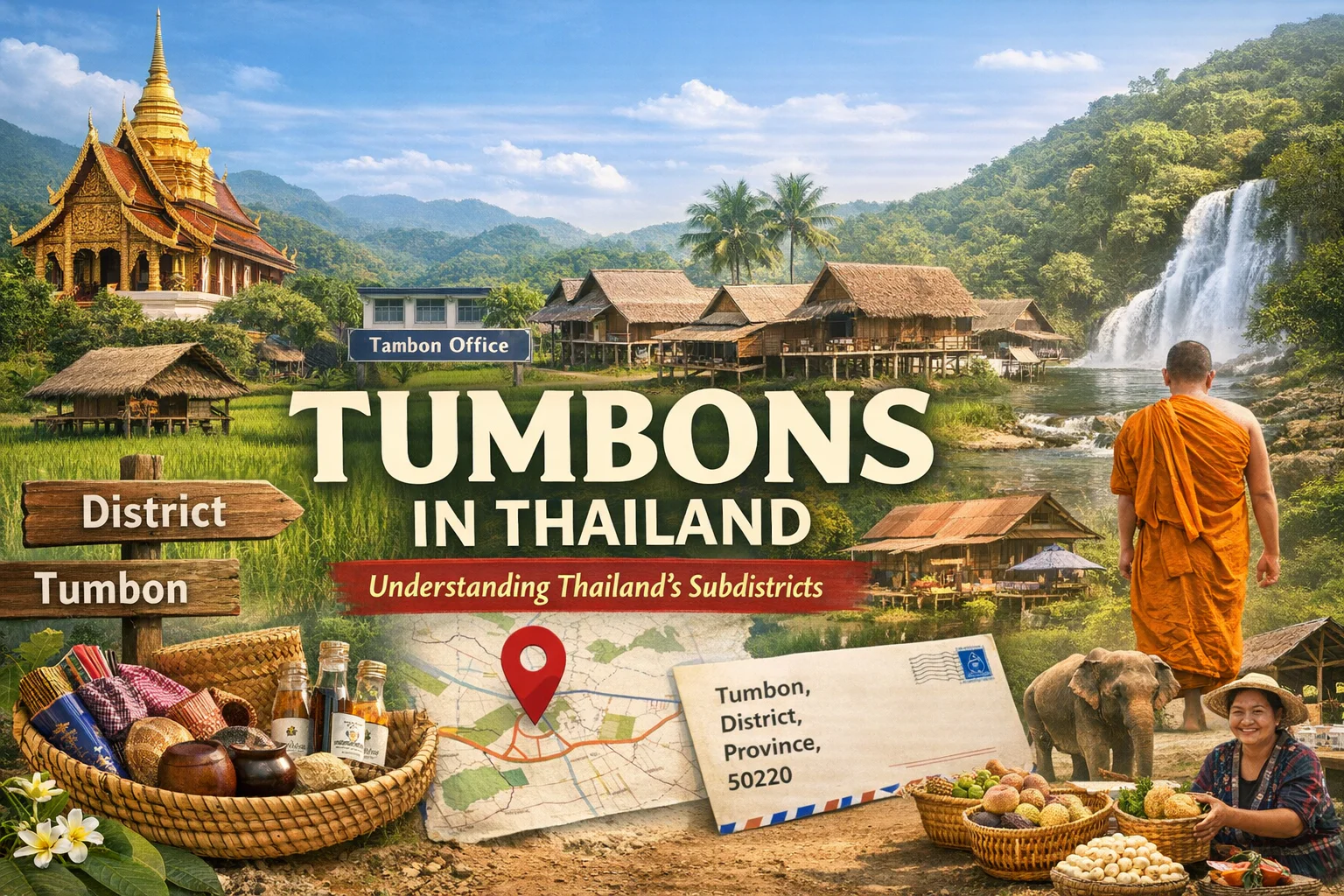
Tumbons
Tumbons are one of those Thailand words you’ll see on maps, forms, and addresses, yet many visitors skip past it. A tumbon (also commonly spelled tambon) is basically a subdistrict. It sits under a district and above villages. If you’re from the USA, think of it as a local area unit that helps organize public services and community management.
Knowing tumbons is useful when you book rural stays, look up temples, follow delivery locations, or handle paperwork like visas, rentals, and banking. It also helps you understand how Thailand runs “local life” outside big cities. In this guide, you’ll learn how tumbons fit into Thailand’s structure, what you’ll find inside a tumbon, and how locals use the term daily. You’ll also get real examples, a clear table, and quick tips that make the idea easy.
What Are Tumbons in Thailand?
Tumbons are the third-level administrative area in Thailand’s system. The usual order is province → district → tumbon → village. Each tumbon groups several villages together, which makes planning and public service easier. This structure matters more than people realize. It affects local roads, small clinics, community schools, waste pickup, and local development plans.
When you travel outside Bangkok, you often see tumbon names on signs, postal addresses, and Google Maps location details. Many areas also have a local office tied to the tumbon. That office supports community needs and basic administration. So, when someone says, “I live in this tumbon,” they are telling you their local area inside a district. For travelers, understanding tumbons reduces confusion, especially in rural provinces where district names repeat.
Province, District, Tumbon, Village: The Simple Breakdown
Thailand is split into provinces, and each province is split into districts. Each district is split into tumbons, and each tumbon is split into villages. This is why two places can share the same district name yet still be different. The tumbon name helps pinpoint the exact area. In many addresses, you will see the tumbon listed right after the district. In the USA, you might be used to “city, county, state.” Thailand works differently, especially outside major cities.
In Bangkok, the terms change, but the level is similar. That’s why people sometimes get confused when they search locations online. Once you learn the tumbon level, addresses start to make sense. It becomes easier to find guesthouses, farms, local markets, and small attractions.
A Clear Table: Thailand Administrative Levels
Below is a quick table to help you understand where tumbons sit and what each level usually does. It’s simple enough to remember, and it helps when you read Thai addresses.
| Level (English) | Thai Term (Common) | What It Means | What It Helps With | Example (Generic) |
|---|---|---|---|---|
| Province | Changwat | Largest local region | Big planning, hospitals, major roads | Chiang Mai Province |
| District | Amphoe | Area inside a province | District offices, key services | Mae Rim District |
| Tumbon (Subdistrict) | Tambon / Tumbon | Group of villages | Local admin, basic services | Rim Tai Subdistrict |
| Village | Muban | Small community unit | Local leadership, daily community needs | Village 3 |
Bangkok uses khet and khwaeng, which match the district and subdistrict levels. So, in Bangkok, the “tumbon-level” idea still exists, just under different words.
Why Tumbons Matter for Travelers and Digital Nomads
If you’re visiting Thailand from the USA, you might not think about local administration. Yet tumbons affect your travel in real ways. Many beautiful stays, eco-lodges, and farms are listed by tumbon and district, not by city names you recognize. Delivery apps and driver directions often depend on correct tumbon details too. If you rent a house, sign a lease, or open certain services, paperwork may ask for your province, district, and tumbon.
Even some travel insurance and hospital intake forms record the tumbon for your location. Also, local events like temple fairs and markets can be tied to the tumbon area. So, learning tumbons is not “politics.” It’s a practical travel skill. It helps you move smoothly, avoid wrong locations, and understand local life beyond tourist zones.
What You’ll Find Inside a Tumbon
Most tumbons include several villages, farmland, small neighborhoods, and local centers like markets or temples. Some tumbons are very rural, with rice fields and quiet roads. Others sit near busy towns and have shops, schools, and small clinics. A tumbon often has local leaders and an admin setup that supports community needs. You might see a small government office, community learning centers, or development projects.
Many tumbons have their own identity too. They may be known for fruit, crafts, fishing, silk, or a special local food. This is one reason Thailand’s local culture feels so rich. Each tumbon can have its own “flavor.” For travelers, exploring by tumbon can lead you to small places that feel real and uncrowded, compared to major tourist hubs.
Tumbons vs. Bangkok: Different Terms, Same Level
Bangkok works differently because it’s a special administrative area. Instead of “district” and “tumbon,” you’ll usually see khet (district) and khwaeng (subdistrict-level). The idea is still the same. It helps divide a big city into manageable parts. If you look at a Bangkok address, you may not see the word tumbon at all. That does not mean the concept disappears. It’s just labeled differently.
This matters for visitors who move between Bangkok and the provinces. In Chiang Mai or Phuket, you’ll see tumbon listings often. In Bangkok, you’ll see khwaeng instead. If you know this, you can fill out forms correctly and avoid confusion during bookings. It also helps when you search places online and see different address formats.
How Tumbons Appear in Thai Addresses
Thai addresses often follow a pattern that can feel unusual to Americans. You may see house number, village number, road, then tumbon, district, province, and postal code. In English listings, tumbon may appear as “Subdistrict.” Some websites also use the spelling “tumbol.” This is why a single place might show different versions in search results. Still, it points to the same level.
When you book a ride, send a package, or register a SIM, the tumbon can help identify your exact area. If two places share a district name, the tumbon tells them apart. For better accuracy, match the tumbon name with the district and postal code. That combination is usually enough to avoid mistakes, even in rural areas.
Local Government: Who Manages a Tumbon?
Many tumbons are managed through local bodies that handle community-level tasks and planning. The goal is simple: keep services close to residents. That can include small road upkeep, public spaces, local rules, and community projects. The exact setup can vary by area size and whether parts fall under a municipality. Some tumbons are partly under municipal control, while the remaining area has its own local administration.
For a visitor, you don’t need to memorize the legal structure. What matters is the outcome. Tumbon-level management is why small communities can run local events, maintain certain services, and apply for development support. When you see clean markets, community signs, or local repair projects, that often ties back to this level of planning.
“One Tambon One Product” and Local Business Culture
One reason tumbons show up online is a program called “One Tambon One Product,” often seen as OTOP. The idea is simple: each tumbon can highlight a strong local product. That could be woven fabric, herbal soaps, pottery, snacks, coffee, or handmade crafts. These products often appear at fairs, local shops, and tourist markets. For American visitors, OTOP is a smart way to buy meaningful items that support local families.
It also makes great gifts, since many items are handmade and tied to place. If you love authentic travel experiences, look for OTOP stores and local fairs. Many are organized at the province or district level, but the identity comes from the tumbon. It’s one of the easiest ways to connect with local Thailand.
Real Examples: How You Might Use the Word “Tumbon”
Here are common moments where tumbons become useful. You book a homestay and the location shows “Tumbon ___.” You ask a driver where a waterfall is, and they confirm the tumbon name to avoid the wrong one. You order a delivery and the system asks for province, district, and tumbon. You register something official and the form needs your tumbon, even if you live short-term.
You also might see a temple listed under a tumbon that’s different from the nearest town name. This happens a lot in rural areas. In daily Thai life, people use tumbon like a location anchor. It’s not fancy, and it’s not tourist-only. It’s simply how places are organized and identified. Once you notice it, it becomes easy.
Common Confusions: Tambon vs Tumbon vs Tumbol
You may see tumbons spelled in different ways online. The most standard spelling is tambon, based on Thai transliteration. But many English speakers type tumbon because it matches the sound they hear. Some old sources also use “tumbol.” These are usually pointing to the same thing: a Thai subdistrict. This matters because spelling changes can affect search results, bookings, and map accuracy.
A smart trick is to search both spellings when you’re looking for a place. If you’re writing an address, copy it from an official source like a booking page, government form, or a trusted location pin. Consistency helps. The good news is that most services recognize the variations, especially in travel-heavy provinces.
Quick Tips: How to Find a Correct Tumbon Fast
If you want to confirm a place quickly, use a simple 3-step check. First, look for the province and district, then confirm the tumbon name. Second, match the postal code if you have it. Third, check the map pin and nearby landmarks like a temple, market, or school. This is especially helpful in areas where several villages share similar names. If you’re traveling, keep a screenshot of your address showing the tumbon and district.
It helps when you’re offline or when a driver asks for confirmation. For long stays, learn the tumbon name where you live. It makes local chats smoother, and it helps with deliveries. These small steps prevent big confusion, and they save time in real life. That’s why tumbons are worth understanding.
FAQs About Tumbons
1) What are tumbons in simple words?
Tumbons are Thai subdistricts. They sit below districts and above villages. They help organize local services and locations. If a district is a big area, a tumbon is a smaller section inside it. Many villages can fall under one tumbon. You’ll often see tumbons in Thai addresses, map listings, and booking details. Understanding the tumbon name helps you find places more accurately, especially in rural provinces. It’s a practical location label that locals use all the time.
2) Are tumbons only in rural areas?
No, tumbons are not only rural. Many are rural, but some are near towns or growing areas. A tumbon can include busy neighborhoods, schools, shops, and local markets. In city zones, some areas may fall under a municipality, which changes local management. Still, the tumbon level can remain part of the address structure in many places. Bangkok is the main exception because it uses different terms, yet the same “subdistrict-level” concept still exists there.
3) How many villages are in a tumbon?
It varies, but a tumbon often includes several villages. Some tumbons are small and may have fewer villages. Others are larger and can include many villages and communities. The main idea is grouping. By grouping villages into a tumbon, local planning becomes easier. It helps manage basic services and community needs. For travelers, you don’t need an exact number. Just remember that a tumbon usually covers more than one village, so it represents a wider local area.
4) What is the difference between a district and a tumbon?
A district is a bigger area inside a province. A tumbon is a smaller unit inside a district. The district is often where larger offices and bigger services sit. The tumbon is closer to the community level. It helps organize villages and local needs. In addresses, district and tumbon appear together because they narrow down the location step by step. If you mix them up, you can end up in the wrong place, especially where names repeat.
5) Why do I see “tambon” on maps but search “tumbon”?
Because spelling varies online. The standard spelling is “tambon,” but many people write “tumbon” based on pronunciation. Some listings also show “subdistrict.” These usually mean the same thing. If you can’t find a place with one spelling, try the other. Also search using the district and province together. That combination usually reveals the correct result. Copying the official spelling from your booking or map pin is the safest approach.
6) Do I need to know tumbons as a tourist?
You don’t have to, but it helps a lot. Tumbons improve address accuracy, delivery success, and ride directions. They also help you understand local areas beyond major cities. If you stay in rural Thailand, you’ll see tumbon names often. Learning the tumbon where you stay can save time, reduce mix-ups, and make conversations smoother with locals and drivers. It’s a small travel skill with a big payoff.
Conclusion: Why Tumbons Are Worth Knowing
Tumbons are a simple idea with real everyday value. They are Thailand’s subdistrict level, and they connect districts to villages. Once you understand that, Thai addresses feel less confusing. Travel becomes smoother too, especially outside big cities. You can find places faster, confirm locations with drivers, and avoid booking mix-ups. You also start to notice local identity, since many tumbons are known for food, crafts, and community culture.
If you’re planning a Thailand trip, a long stay, or even writing about Thailand for an American audience, tumbons are an easy topic that adds clarity and trust. Save the table from this guide, and use the quick tips when you search locations. The next time you see a tumbon name, you’ll know exactly what it means and why it matters.
You May Also Like To Read: Ditch the Boring Brochures
About the Author
