What Is a Conjugate Base and Why Does It Matter in Chemistry?
 Admin USA Journalist
Struggling to figure out how acids and bases transform during chemical reactions? Trying to keep track of missing protons can feel completely overwhelming and confusing.
Fortunately, understanding what is a conjugate base becomes simple once you learn how molecules swap hydrogen ions.
Understanding the Bronsted-Lowry Theory
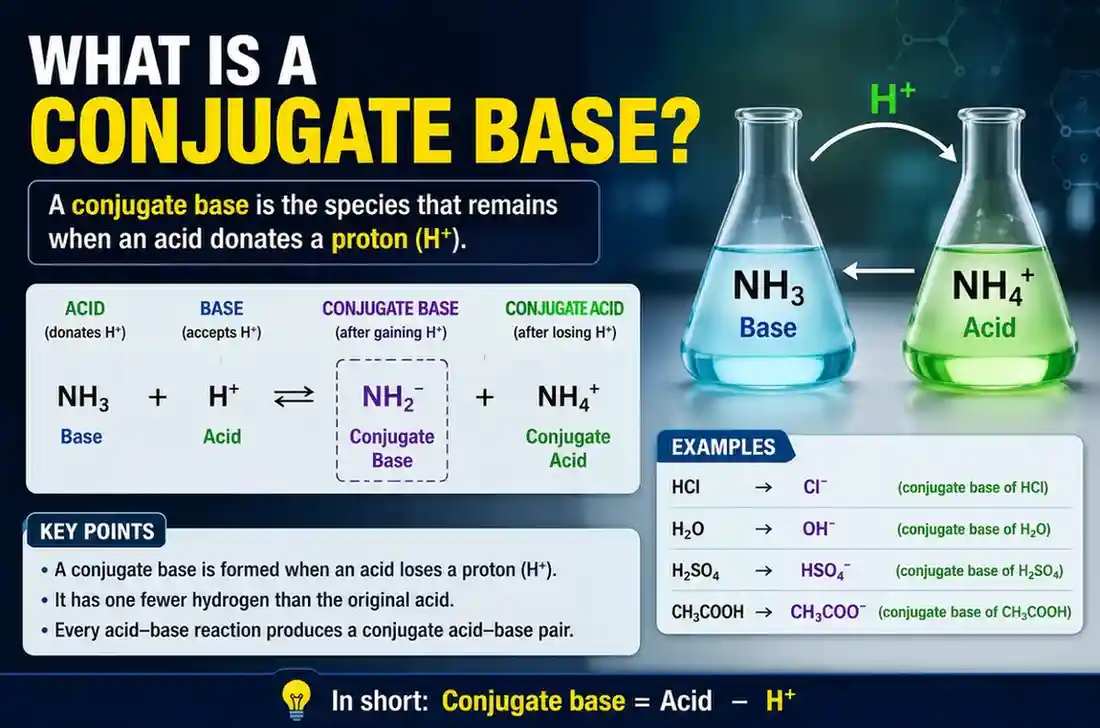
The Bronsted-Lowry definition forms the bedrock of modern acid-base chemistry. In this framework, acids act as proton donors, while bases act as proton acceptors. When an acid gives away a proton ($H^+$), the particle that remains behind is known as its conjugate base.
This relationship operates as a continuous two-way street. Every time you mix chemicals, reactant pairs transform into new products that can reverse the process.
What Is a Conjugate Base? (Definition & Core Concept)
A conjugate base is precisely what is left over after an acid donates a hydrogen ion during a chemical reaction. Think of it as the opposite side of a coin. If a molecule starts as an acid, losing its hydrogen turns it into a species hungry to get that proton back.
- Key characteristic: It always has one fewer hydrogen atom than its parent acid.
- Charge impact: Its electrical charge decreases by one compared to the original acid.
- Function: It stands ready to accept a proton in the reverse reaction.
How Conjugate Acid-Base Pairs Work
Chemical reactions do not happen in isolation. They form conjugate pairs that work together in harmony. Whenever an acid loses a proton to become a conjugate base, the base that accepts that proton turns into a conjugate acid.
- Acid 1 + Base 2 $\rightleftharpoons$ Conjugate Base 1 + Conjugate Acid 2
This constant exchange creates chemical equilibrium. Recognizing these pairs lets you predict the exact direction a reaction will take.
Step-by-Step Examples of Common Conjugate Bases
Seeing real chemical formulas makes abstract rules much easier to grasp. Here are three everyday examples of acids and their resulting conjugate bases:
- Hydrochloric Acid ($HCl$): When hydrochloric acid donates its proton, the chloride ion ($Cl^-$) remains. Therefore, $Cl^-$ is the conjugate base of $HCl$.
- Acetic Acid ($CH_3COOH$): Found in vinegar, acetic acid loses a hydrogen ion to become the acetate ion ($CH_3COO^-$).
- Water ($H_2O$): Water can act as an acid. When it donates a proton, it forms the hydroxide ion ($OH^-$).
Strong Acids vs. Weak Acids and Their Bases
The strength of an acid directly dictates the strength of its corresponding partner. Chemistry follows a strict inverse rule regarding proton attraction.
- Strong Acids: Acids like sulfuric acid or hydrochloric acid dissociate completely. Their resulting conjugate bases are extremely weak because they have zero affinity to reabsorb protons.
- Weak Acids: Acids like carbonic acid dissociate only partially. Their resulting conjugate bases remain relatively strong because they actively hold onto or recapture hydrogen ions.
Comparison Table: Common Acids and Their Conjugate Bases
| Original Acid | Chemical Formula | Conjugate Base Formed | Formula After Proton Loss |
| Hydrochloric Acid | $HCl$ | Chloride Ion | $Cl^-$ |
| Nitric Acid | $HNO_3$ | Nitrate Ion | $NO_3^-$ |
| Acetic Acid | $CH_3COOH$ | Acetate Ion | $CH_3COO^-$ |
| Water | $H_2O$ | Hydroxide Ion | $OH^-$ |
| Ammonium Ion | $NH_4^+$ | Ammonia | $NH_3$ |
Role of Conjugate Bases in Buffer Solutions
Buffers are specialized solutions that resist drastic changes in pH when scientists add acids or bases. They achieve this stability by pairing a weak acid with its salt, which contains the conjugate base.
When extra acid enters the system, the conjugate base absorbs the new protons. When extra base enters, the weak acid donates protons to neutralize it. This balancing act keeps biological systems, like human blood, operating safely.
Determining Charge and Formula Changes
Predicting the formula of a new chemical species requires basic math and logic. Every single proton carries a single positive charge.
When a neutral molecule like water ($H_2O$) loses a positive hydrogen ion, it keeps the extra electrons behind, resulting in a negative charge ($OH^-$). If a positively charged molecule like the ammonium ion ($NH_4^+$) loses a proton, it neutralizes into plain ammonia ($NH_3$).
Real-World Applications in Biology and Industry
Understanding what is a conjugate base extends far beyond textbook chemistry problems. Medical professionals rely on bicarbonate buffers to regulate human blood pH.
Industrial manufacturing plants use acid-base chemistry to treat wastewater, synthesize pharmaceuticals, and manufacture fertilizers safely. Mastering these interactions unlocks practical problem-solving skills across multiple scientific fields.
Frequently Asked Questions
What is a conjugate base in simple terms?
It is the particle that remains after an acid gives away a hydrogen ion during a chemical reaction.
How do you find the conjugate base of any formula?
Simply remove one hydrogen atom ($H$) and subtract one positive charge from the original acid formula.
Is a conjugate base always negatively charged?
Not always. While many carry a negative charge, they can also be completely neutral depending on the starting charge of the parent acid.
What is the difference between an acid and its conjugate base?
The only difference is a single hydrogen ion ($H^+$) that the acid possesses and the base lacks.
Can a conjugate base act as an acid later?
Yes. Many can accept or donate protons depending on the chemical environment, a property known as amphoterism.
Why are strong acids paired with weak conjugate bases?
Because a strong acid gives up its proton so easily, the resulting base has very little attraction to pull that proton back.
Conclusion
Mastering chemical reactions becomes straightforward once you track how protons move between molecules. Knowing what is a conjugate base gives you the power to predict outcomes, balance equations, and understand complex biological buffers. Take this knowledge, apply it to your studies, and start solving chemical equations with absolute confidence today!
Recommended For You