
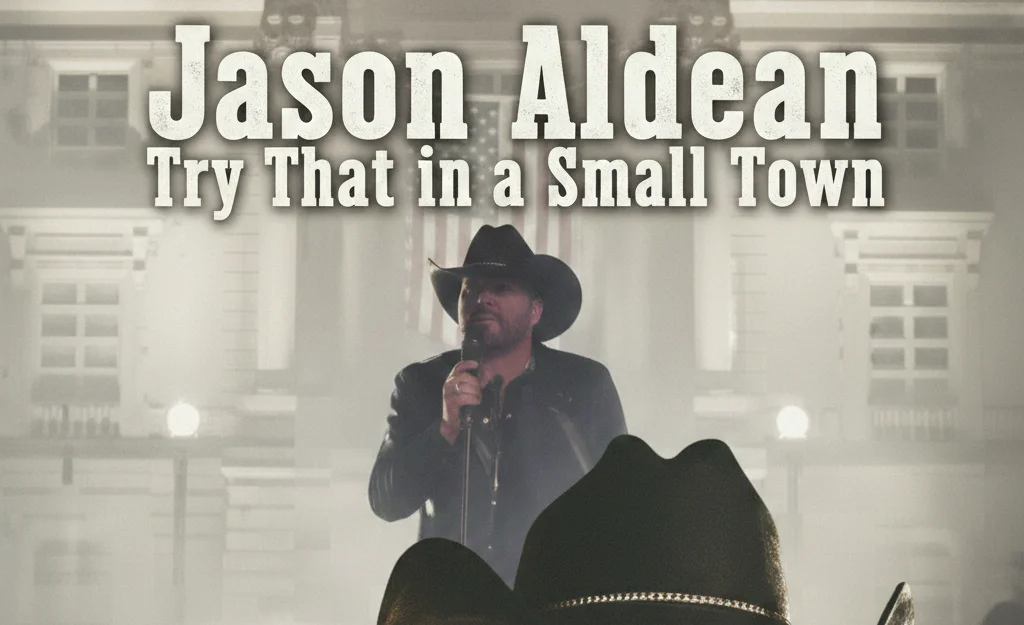
Try That in a Small Town
Some songs just play on the radio. You hear them at the grocery store or while waiting in line for coffee. They come and go, and you barely notice. Then there are songs like “try that in a small town.” This one did not just play. It arrived. It sat down at the table. It looked around the room and refused to leave.
When Jason Aldean released this track in the summer of 2023, nobody expected what came next. Sure, he was already a country music giant with dozens of hits under his belt. But this song was different. It felt heavier from the very first listen. It carried something that people could not shake off. The melody stuck with you, sure, but the message stuck even harder.
For folks who grew up in small towns, the song felt like a handshake. It reminded them of Sunday dinners after church. It reminded them of neighbors who showed up with a casserole when somebody got sick. It reminded them of front porches and knowing every face on your street. It was not just music. It was memory.
But for others, the song raised questions. They wondered what the lyrics really meant. They wondered about the video and the old courthouse. They wondered if this was a song about community or something else entirely. And that wondering turned into conversation. Those conversations turned into debate. And pretty soon, everybody had something to say about Jason Aldean try that in a small town.
Here is the thing about powerful songs. They do not need you to agree with them. They just need you to feel something. And whether you love this track or you question it, you cannot deny that it made people feel. It woke something up. It reminded us that music can still matter. It can still start arguments at dinner tables. It can still make you turn up the volume or turn it off in frustration.
This article is not about taking sides. It is about understanding. We are going to walk through everything that makes this song what it is. We will look at the lyrics line by line. We will meet the talented songwriters behind the words. We will visit the small town where the video was filmed. We will talk about the shirts and the memes and the chart records. We will sit with the controversy and the celebration.
By the time you finish reading, you will know exactly why this song became what it became. You might still love it. You might still question it. But you will understand it. And really, that is all any song can ask for.
So pull up a chair. Get comfortable. Let us take a trip down that long, familiar road and explore what really happens when you try that in a small town.
The Story Behind Jason Aldean Try That in a Small Town
Every great song starts somewhere. Sometimes it starts with a guitar riff. Sometimes it starts with a heartbreak. Sometimes it starts with a feeling that has been building for years. For Jason Aldean try that in a small town, it started with four guys in a room who were tired of watching the world change in ways they did not recognize.
Kelley Lovelace, Kurt Allison, Neil Thrasher, and Tully Kennedy sat down to write. They were not trying to make a statement. They were not trying to start a fire. They were just trying to put words to something they felt in their bones . Kurt and Tully were not just songwriters. They played in Jason’s band. They spent years on tour buses looking out at small-town crowds. They watched people come together after long days of work. They saw communities hold each other up when times got hard.
That is where the song was born. Not in a boardroom. Not from a marketing meeting. It came from years of watching folks show up for each other. It came from seeing a farmer help his neighbor bale hay. It came from watching a church congregation feed families who could not afford dinner. It came from knowing that in small towns, you do not ask for help. Help just shows up.
When they wrote the lyrics, they kept things simple. They did not try to be poets. They tried to be honest. They wrote about carjacking an old lady at a red light. They wrote about pulling a gun on a liquor store owner. They wrote about spitting on a cop and stomping on the flag. These were not random images. These were headlines they saw on the news every single night. And they wondered, quietly, what would happen if that behavior showed up on Main Street .
The answer came in the chorus. Try that in a small town. See how far you make it down the road. Around here, we take care of our own. You cross that line, it will not take long for you to find out. It was not a threat. It was just truth. At least, it was their truth.
When Jason heard the demo, he knew immediately. This was not just another track for the album. This was something he needed to sing. He had grown up in Macon, Georgia. Not a big city. Not a tiny dot on the map, but small enough that people knew your name. He understood that unspoken rule. We all have each other’s backs. We look out for each other. Somewhere along the way, he felt like that sense of community had gotten lost .
So he recorded it. He put his voice behind those words. He did not know that in a few short weeks, the whole country would be talking about Jason Aldean try that in a small town. He did not know that politicians would play it at rallies. He did not know that news anchors would debate it. He just knew it was true. And sometimes, that is enough.
Breaking Down Try That in a Small Town Lyrics
Words matter. In a three-minute song, every single syllable carries weight. When you listen closely to try that in a small town lyrics, you start to see the picture the songwriters were painting. It is not complicated. That is what makes it so powerful.
The song opens with scenes of chaos. Sucker punch somebody on a sidewalk. Carjack an old lady at a red light. Pull a gun on the owner of a liquor store. These are not hypotheticals. These are stories we see on the evening news. We shake our heads. We change the channel. We feel helpless because it happened somewhere else, to someone else.
Then the song shifts. It asks a simple question. What if that happened here? Not on the other side of the city. Not in a neighborhood you never visit. What if it happened on your street, in your town, in front of your family? The song suggests the response would be different. Not because small-town people are tougher. Because they are closer. When you know your neighbor by name, you do not just call 911. You walk outside. You check on them. You make sure they are okay .
The second verse hits even harder. Got a gun that my granddad gave me. They say one day they are gonna round up. That line made people stop and think. Some heard a defense of the Second Amendment. Others heard something more complicated. But the songwriters said it came from a different place entirely. It came from Las Vegas. It came from October 2017. It came from standing on a stage when the bullets started flying .
Jason was performing at the Route 91 Harvest Festival when a gunman opened fire on 22,000 people. Fifty-eight died. Hundreds were wounded. Jason and his band ran for their lives like everybody else. That night changed him. It changed the way he saw the world. When he sings about that granddad gun, he is not talking about politics. He is talking about trauma. He is talking about a country where that kind of horror keeps happening, even in small towns like Uvalde and Newtown and Parkland .
The chorus repeats like a heartbeat. Try that in a small town. See how far you make it down the road. It is not complicated poetry. It is plain speech. It is the way people actually talk. And maybe that is why jason aldean try that in a small town lyrics stuck in so many heads. They were not fancy. They were familiar.
Some critics said the song was angry. But the songwriters push back on that. They say it is not about anger. It is about exhaustion. It is about being tired of watching people hurt each other. It is about wanting to go back to a time when things made more sense. Not a perfect time. Just a simpler one .
When you read lyrics to try that in a small town jason aldean, you notice what is missing. There are no names of cities. There are no political parties. There is no race mentioned at all. Jason pointed this out himself when the controversy erupted. There is not a single lyric in this song that references race. Not one . The song is about behavior. It is about choices. It is about consequences. Everything else got added by listeners who brought their own experiences into the music.
That is what good songs do. They hold space for you to find yourself inside them.
Who Wrote Try That in a Small Town? Meet the Talented Team
Great songs do not write themselves. They come from real people with real stories. So who wrote try that in a small town? The answer is four men who have spent their lives inside country music.
Kelley Lovelove has been writing hits for decades. He knows how to craft a hook that stays in your head for days. Neil Thrasher brought his gift for melody and his sharp eye for detail. But the two names that matter most for this song are Kurt Allison and Tully Kennedy .
These guys are not just writers. They are road warriors. They have played guitar and bass for Jason Aldean for years. They have logged millions of miles on tour buses. They have looked out at thousands of crowds in hundreds of towns. They have seen America up close, not from an airplane window but from ground level.
When they sat down to write, they were not thinking about controversy. They were thinking about community. Tully Kennedy explained it simply. This song is about common sense. It is about wanting to believe in neighborly communities where people do not punch the elderly in the face or spit on police officers or burn the American flag. That should not be a political statement. That should just be normal .
Kurt Allison admitted they were stunned by the reaction. They thought they were writing a straightforward country song. Something people could nod along to. Something that would fit right alongside Toby Keith’s “Courtesy of the Red, White and Blue” or Hank Williams Jr.’s anthems about being proud of where you come from. They did not expect to be called names. They did not expect to be accused of racism .
The accusation hurt them. It hurt deeply. They have spent their careers backing up a man who has played for every kind of crowd, in every kind of town. They have seen Jason hug Black fans and white fans and brown fans. They have watched him sign autographs until his hand cramped. They are not the monsters some people made them out to be .
After the storm settled, Kurt and Tully did something interesting. They started a podcast. The Try That in a Small Town Podcast explores the common-sense values that sparked the song. They talk to people they disagree with. They try to have honest conversations. They believe that artistic and intellectual freedom matter. They believe that just because you disagree with somebody does not mean you have to hate them .
Who sings try that in a small town? Everybody knows that is Jason Aldean. But who wrote try that in a small town? Now you know their names too. Kelley, Kurt, Neil, and Tully. Four guys who wrote a song that became much bigger than they ever imagined.
The Courthouse in Columbia: Why Location Mattered
When the music video dropped, people noticed the building right away. It was not a random street corner. It was not a generic backdrop. It was the Maury County Courthouse in Columbia, Tennessee. And that building carries history on its shoulders .
Columbia sits about forty-five minutes south of Nashville. It is the kind of town where everybody knows the square. You go there for farmer’s markets and Fourth of July parades. You take pictures in front of the old stone columns. It looks like the postcard version of small-town America.
But the postcard does not tell the whole story. In 1927, an eighteen-year-old Black man named Henry Choate was accused of a crime. He denied it. The victim could not identify him. None of that mattered. A mob dragged him from his jail cell, tied him to a car, pulled him through the streets, and hanged him from the second floor of that very courthouse .
That is the history that sat behind Jason Aldean while he sang. That is the ground he stood on.
When critics saw the video, they connected the dots immediately. They pointed out that the same building that hosted a lynching nearly a century ago was now hosting a song about vigilantism. They called it a modern lynching song. They called it dangerous .
Jason pushed back hard. He said he did not choose the location. His director did. The production company explained that the courthouse is a popular filming spot. Parts of Hannah Montana: The Movie were shot there. Nobody was thinking about 1927. They were thinking about good lighting and classic architecture .
But intention and impact are two different things. You can mean no harm and still cause pain. You can be ignorant of history and still stand on top of it. The mayor of Columbia, Chaz Molder, handled it carefully. He said he respects Jason’s freedom to write his own lyrics. But he also hoped that the next music video filmed in his town would seek a more positive message. He emphasized that Columbia is focused on bringing people together .
That statement captured the tension perfectly. A town cannot erase its past. It can only decide what to do with it. The same courthouse that witnessed violence now witnesses weddings and civic meetings and concerts. It holds both realities at once. So does the song.
The video was pulled from CMT after only three days. The network never officially explained why. But the message was clear. Some lines had been crossed, whether Jason meant to cross them or not .
What is interesting is that Jason was still invited to perform at the CMT Awards months later. He even received a nomination for Video of the Year. The network that banned his video still wanted him on their stage. It was confusing. It was contradictory. It was very American .
Why CMT Pulled the Video and What It Meant
When CMT made the decision to stop airing the video, the news spread fast. People on both sides had something to say. Supporters called it censorship. Critics called it accountability. The truth, as always, lived somewhere in the messy middle .
CMT never gave an official reason. They confirmed the pull. They declined to comment further. That silence spoke volumes. It suggested the decision was not made lightly. It suggested they knew whatever they said would only add fuel to the fire .
For Jason’s fans, the ban was proof that the system was rigged. They saw a country artist being silenced by the same corporate machinery that promoted everyone else. They saw hypocrisy. How could CMT pull this video while leaving others untouched? How could they invite Jason to perform at their award show after telling him his art was not welcome on their airwaves?
For critics, the ban was overdue. They believed the video crossed a line. They believed the imagery was irresponsible. They believed that platforming a song filmed at a lynching site, regardless of intent, sent a dangerous message. They were glad CMT made a choice, even if they wished it had come faster .
The ban had an unexpected side effect. It made the song bigger. When people are told they cannot have something, they want it more. Jason Aldean try that in a small town shot to number one on the iTunes chart. Supporters bought it in droves. They shared it on social media. They made it clear that pulling the video did not pull the song .
This is the paradox of controversy in the streaming era. Attempts to stop the spread of content often accelerate it. Every news article about the ban included a link to the song. Every debate on cable television played clips from the video. People who had never heard of the track before Tuesday were humming it by Friday.
The songwriters watched all of this unfold with whiplash. One day they were proud of their work. The next day they were defending their character. They kept coming back to the same point. We are not political people. We are just musicians. We wrote a song about community. Everything else got added on top .
But here is the hard truth. When your art enters the world, it no longer belongs only to you. People will hear it through their own ears. They will see it through their own eyes. They will bring their own history and pain and hope into the room with them. You cannot control that. You can only decide whether you are willing to let the song exist on its own terms.
Jason decided he was willing. He did not change the lyrics. He did not reshoot the video. He did not apologize for something he did not believe he did wrong. He stood still and let the music carry the weight . Some people respected him more for that. Some people respected him less. But nobody could say he folded.
Try That in a Small Town Shirt: Wearable Pride
When a song becomes a movement, merchandise follows. Almost immediately, the try that in a small town shirt became a thing. You saw them at concerts. You saw them at county fairs. You saw them in Facebook photos posted by proud supporters who wanted to make their allegiance visible .
The shirts were simple. Usually black. Usually bold white letters. Sometimes featuring the song title. Sometimes featuring a line from the chorus. Sometimes just an American flag next to the words. Nothing complicated. Nothing artsy. Just a statement.
Why do people buy shirts like this? It is not about fashion. Nobody is buying a try that in a small town shirt because it matches their sneakers. They buy it because it says something they believe. It is a flag they can wear. It signals to other like-minded people that we are on the same team.
The shirt became a conversation starter. Supporters wore it to the grocery store and found strangers nodding at them in the produce aisle. Critics saw it and felt frustrated. The clothing turned abstract debate into something visible and unavoidable. You cannot scroll past a shirt. You have to walk past it. You have to sit next to it at a stoplight. It demands a reaction .
Some companies rushed to produce official merchandise. Others, like the Gary Glenn shirt sold on various sites, tried to capitalize on the moment. They promised high-quality fabric and fast shipping. They used urgency tactics. Limited stock. Act fast. Grab yours before it is gone. The controversy was not hurting their business. It was helping it .
What is interesting is how the shirts mean different things to different people. For some, wearing the song is a way to support Jason Aldean personally. They have been fans since his first album. They have defended him through every tabloid story and every controversy. This is just the latest battle in a long war.
For others, the shirt has nothing to do with the singer. It is about the message. It is about standing up for small towns. It is about rejecting the chaos they see on the news. It is about declaring that their community still holds the line. The song could have been recorded by anybody. It just happened to be Jason.
And for a smaller group, the shirt is ironic. They wear it to provoke. They wear it to see who reacts. They are not deeply invested in the politics or the music. They just like watching the tension it creates.
Whatever the reason, the try that in a small town shirt became part of the story. It proved that this song was not just streaming on playlists. It was hanging in closets. It was getting worn and washed and worn again. It was becoming part of everyday life.
Try That in a Small Town Meme: Internet Culture Takes Over
You cannot have a cultural moment in 2023 without memes. The internet moves fast, and it chews up everything it touches. Try that in a small town meme variants spread across Twitter, TikTok, and Instagram. Some were funny. Some were pointed. Some were just weird.
The format was flexible. People took the basic premise and applied it to ridiculous situations. Try that in a small town, like trying to order a latte with oat milk. Try that in a small town, like asking for the manager at the local diner. Try that in a small town, like parallel parking on Main Street. The humor worked because the song had become so serious. Memes were a release valve.
Other memes were more critical. They juxtaposed the lyrics with statistics about mass shootings in rural communities. They pointed out that Uvalde is a small town. Parkland is a small town. Newtown is a small town. The song’s promise of safety did not match the reality of gun violence in places just like the ones Jason was singing about .
Still other memes were purely political. They used the song to mock liberal activists. They created split screens with Jason performing and Joe Biden speaking. They turned the chorus into a rally cry for conservative candidates. The song became a prop in the endless performance of online warfare.
Jason himself did not engage much with the meme culture. He posted his statement defending the song and then largely stayed out of the comment sections. But his silence did not stop the memes. If anything, it encouraged them. The absence of official commentary left space for everyone else to fill .
What the memes revealed is that try that in a small town had transcended music. It was no longer just something you listened to. It was something you reacted to. It was raw material for whatever argument you wanted to make. The song had become a mirror, and the memes were the faces people made when they looked into it.
This is not necessarily bad. Some songs fade away because nobody cares enough to argue about them. This one stuck around because people felt strongly, on both sides, in both directions. Memes are not the enemy of art. Sometimes they are proof that art still matters.
What Small Town Values Really Mean Today
Everybody talks about small town values. But what do those words actually mean in 2026? The phrase gets thrown around a lot, but rarely defined. It is worth pausing to ask the question.
For the songwriters, small town values come down to one thing. Taking care of your own. Tully Kennedy said it plainly. We believe in neighborly communities where people do not punch the elderly in the face, spit on police officers, or burn the American flag. That is not nostalgia. That is common sense .
For many listeners, small town values are about visibility. In a city, you can be anonymous. You can walk for blocks without seeing a familiar face. Nobody knows your name. Nobody knows your parents or your kids or your history. That freedom is appealing to some. But it also means nobody is watching out for you. Nobody notices when you do not show up.
In a small town, people notice. They notice your car in the driveway. They notice your mail piling up. They notice you missing from church on Sunday. That can feel suffocating if you value privacy. But it can also feel like a safety net. When you fall, there are people there to catch you.
Small town values are also about continuity. You live in the house your grandfather built. You fish in the creek your father fished. You know the land because it has been in your family for generations. That connection to place is hard to explain to someone who has moved every few years. It is not just where you are. It is who you are.
Critics of the song argue that this vision of small town life leaves people out. They point to the history of exclusion. They note that for much of American history, small towns were not welcoming places for Black families or immigrant families or LGBTQ families. The nostalgia for a simpler time ignores the fact that simpler often meant more segregated .
This critique is not wrong. But it is also not complete. Small towns are not frozen in 1950. They change. They evolve. The same Columbia, Tennessee that witnessed a lynching in 1927 is now a diverse, growing community with a Black mayor and a commitment to telling the full truth about its history. Places can hold both their failures and their progress.
Maybe small town values are not about perfection. Maybe they are about proximity. When you live close to people who are different from you, you have to figure out how to get along. There is no hiding. There is no retreating to your own neighborhood. You share the same grocery store, the same post office, the same high school football games. You learn each other, not through headlines, but through daily life.
That is what the song reaches for. Not a perfect past. Just a better present.
The Songwriters Speak: One Year Later
A full year passed. The controversy cooled. The news cycle moved on to other fights and other songs. But Kurt Allison and Tully Kennedy kept thinking about what happened. So they started talking about it. They launched the Try That in a Small Town Podcast to explore the ideas their song had sparked .
The podcast is not what you might expect. It is not a grievance machine. It is not a daily dose of outrage. It is two middle-aged musicians trying to have honest conversations with people they disagree with. They want to understand how their song, which felt so simple to them, became so complicated to everyone else.
Kurt admitted the accusations of racism stung. He said they were not like that in any way. Neither is Jason. Neither is the band. Being accused of racial insensitivity hurt because they have spent their careers playing music for everybody, regardless of background or belief .
Tully reflected on the changing landscape of country music. Twenty years ago, you could sing a song about patriotism and nobody questioned it. Now every lyric gets scanned for hidden meanings. Every artist gets sorted into opposing camps. You are either with us or against us. There is no middle ground left .
They compared their song to Toby Keith’s post-9/11 anthem. That song was angry too. It promised payback. It made people uncomfortable. But it was not banned. It was not called a lynching song. Something shifted between 2002 and 2023. The temperature got hotter. The grace got thinner.
Still, they remain proud of what they made. They believe the song resonated because it tapped into something real. Americans are tired of watching each other suffer. They are tired of crime and chaos and cruelty. They want to believe that somewhere, people still look out for each other. That belief is not political. It is human .
One year later, the song remains on playlists. It remains in debates. It remains, stubbornly, in the culture. It will not fade quietly into the background. It is too heavy for that. Too many people have wrapped their own meanings around it. It belongs to them now as much as it belongs to the four guys who wrote it in a room, trying to capture something they felt but could not quite name.
How the Song Became a Political Soundtrack
You cannot separate this song from politics. Not because Jason Aldean wanted it that way. He insisted repeatedly that he is not a political artist. He just sings what he feels. But the moment his song became a number one hit and a cultural flashpoint, politicians noticed.
Donald Trump played it at rallies. Ron DeSantis tweeted support. Vivek Ramaswamy praised Jason for defending values all Americans used to share. The Republican primary candidates lined up to claim the song as their own . They saw an opportunity. Here was a country star being attacked by the media. Here was a song topping charts despite the controversy. Here was proof that the conservative base was energized and ready to fight.
Jason did not stop them. He did not endorse any candidate. He did not appear on stages with them. But he also did not tell them to stop playing his music. His silence on that front was interpreted as endorsement, whether he meant it that way or not.
Democrats criticized the song. Some called it shameful. Some called it dangerous. Representative Justin Jones of Tennessee condemned it as a heinous song calling for racist violence. Sheryl Crow tweeted that there is nothing small-town or American about promoting violence. Margo Price spoke out against it .
The polarization was complete. You could predict someone’s opinion of the song based entirely on their party registration. No nuance. No gray area. Just two sides shouting past each other.
What got lost in all the noise was the song itself. It stopped being about music. It became a Rorschach test. People heard what they wanted to hear. They saw what they wanted to see. The actual lyrics, the actual intent, the actual humanity of the people who made it, all faded behind the wall of commentary .
This is the fate of art in a hyper-partisan age. Everything gets absorbed into the machine. Everything becomes content for the never-ending argument. Songs are not experienced anymore. They are deployed.
But maybe that is okay. Maybe songs that matter have always been used this way. Woody Guthrie’s songs were sung at labor rallies. Bob Dylan’s songs were quoted in civil rights speeches. Music does not exist in a vacuum. It exists in the world, and the world uses it for its own purposes.
Jason Aldean try that in a small town is not the first song to be politicized. It will not be the last. But it stands as a perfect example of how hard it is to make something simple in a time that demands you take sides.
Frequently Asked Questions
Who sings try that in a small town?
Jason Aldean sings this powerful country song. He released it in May 2023 as part of his ongoing musical journey. Jason has been a country music star for many years with dozens of hits before this one.
Who wrote try that in a small town?
Four talented songwriters wrote the track. Their names are Kelley Lovelace, Kurt Allison, Neil Thrasher, and Tully Kennedy. Kurt and Tully also play in Jason Aldean’s touring band .
What are the main try that in a small town lyrics about?
The lyrics describe bad behavior like carjacking, robbery, and disrespecting police. The song then asks what would happen if someone tried those things in a small town. The answer is that the community would not allow it .
Why did CMT pull the music video?
CMT pulled the video in July 2023 after three days of airing it. The network never gave an official reason. Many believe it was due to controversy over the filming location and the imagery used in the video .
Where was the video for try that in a small town filmed?
The video was filmed at the Maury County Courthouse in Columbia, Tennessee. This location later became a major part of the controversy because of its historical connection to a 1927 lynching .
What did Jason Aldean say about the controversy?
Jason said the song is not about race. He pointed out that there is no lyric referencing race anywhere in the song. He said the song is about the sense of community he grew up with, where neighbors take care of each other .
Did the song become popular despite the backlash?
Yes, it became very popular. It hit number one on the iTunes chart right after the controversy started. It also topped the Billboard Hot 100 chart. The debate made more people listen to it .
What is the try that in a small town shirt about?
The shirt is merchandise that supporters wear to show they agree with the song’s message. It became a symbol of pride for many fans. Various versions are sold online and at concerts .
Is there a try that in a small town meme?
Yes, many memes spread across social media. Some were funny and lighthearted. Others were serious and critical. The song became a popular subject for internet culture on both sides .
Did the songwriters apologize for the song?
No, they did not apologize. They said they were surprised by the reaction but stood by their work. They believe the song is about common-sense values that everyone should support .
Conclusion: Why This Song Still Matters
There is a moment in every great song where it stops belonging to the artist and starts belonging to the listener. That moment came early for try that in a small town. Jason Aldean and his songwriters sent it out into the world. The world took it and ran.
Some people ran toward it. They heard a voice speaking for them, singing about a life they recognized. They heard their own front porches and county fairs and Sunday mornings. They heard protection. They heard pride. They heard home.
Other people ran away from it. They heard a warning from a past they thought we had left behind. They heard exclusion dressed up as community. They heard danger. They heard threat. They heard everything they were afraid of.
Both groups heard something real. That is the mystery of art. It does not deliver a single message. It delivers a thousand messages, and each listener chooses which one to receive.
What we can all agree on is this. The song made us talk. It made us argue. It made us sit at dinner tables and scroll through comment sections and turn up the radio just to hear it one more time. It interrupted our daily routines and demanded our attention. How many songs can say that?
A year later, the headlines have faded. The hot takes are cold. The politicians have moved on to newer controversies. But the song remains. It sits on playlists next to Merle Haggard and Alabama and Toby Keith. It sits in closets on t-shirts that still get worn to tailgates and tractor pulls. It sits in the hearts of people who never stopped believing that small towns still matter.
Jason Aldean did not set out to write an anthem. He just wanted to sing about something true. He found that truth in the faces of his fans, in the hands of his bandmates, in the quiet dignity of communities that keep showing up for each other year after year.
Try that in a small town. Maybe you already have. Maybe you live there. Maybe you left but still carry it with you. Maybe you have never set foot in a town of five hundred people but you understand the feeling anyway. Community is not a place. It is a choice. You choose to show up. You choose to care. You choose to take care of your own.
That is what the song is really about. Not division. Not politics. Not controversy. Just people, standing together, refusing to let the world tear them apart.
And that is a message worth singing about.
You Also Like To Read: Megan Moroney Tour 2025: Tickets & Must-Hear Songs!
About the Author
